
Metabarcoding outgrew custom pipelines. spcfy is what comes next.
Shared infrastructure for labs, bioinformaticians, and researchers who need DNA Metabarcoding data to be reproducible, comparable, and decision-ready. One standard, every project, every lab. Not in months. In hours.
Not ready for a demo? Read the workflow documentation →
Covering CO1, 16S, ITS2, 12S, PITS2. Animals, plants, fungi, bacteria.
Creating a global ecosystem for biodiversity data.
spcfy connects data producers who generate and process biodiversity data with data users who need reliable results for research, monitoring and decisions. Pick your role, or follow the shared logic from FASTQ to insight.

Working across more than one role? Many research institutes, consultancies and lab teams do. spcfy is built to connect these roles on one shared foundation, not to lock them into separate tools.
DNA Metabarcoding has outgrown spreadsheets.
A single project generates thousands of OTUs across hundreds of samples, each with ecological metadata. Species lists do not carry that complexity. Lab-specific pipeline stacks do not scale with it.
You need infrastructure built for this volume.
Without it, every new project starts from scratch. Every comparison needs a caveat. Every dataset ages the moment the next reference database version drops.
Raw sequence output has no memory.
spcfy gives it one.
Every OTU gets a stable identity. Every result carries its pipeline version, its reference database, its QC threshold. Your 2024 data is still comparable in 2026.
Standardized results across labs, databases, and time.
Every order goes through a multi-database consensus pipeline, built by bioinformaticians who run their own labs.
SPARK · Consensus Taxonomy
SPARK evaluates all BLAST hits and selects the most reliable match using a weighted score that combines identity, taxonomic resolution, and consistency across hits. Do not rely on a single top hit, identify the overall best. Robust. Precise. Built for reproducibility.
LCA · Taxonomic Annotation
spcfy applies a rich set of taxonomic annotations, worldwide or regional BOLD, NCBI GenBank, SILVA, UNITE, RDP, tailored to different amplicons. It then condenses them into a Least Common Ancestor taxonomic consensus. Built for easy interpretability.
SPIN · Stable OTU Identity
SPIN gives each group of near-identical sequences a spcfy Identification Number, analogous to a BIN but not limited to CO1. The same DNA signal keeps one identity across orders, labs and time, with a page you can cite. Consistent tracking. Direct comparability of taxa across samples, projects, and time.
Speak to your data
Ask questions across your biodiversity datasets in plain language. Surface patterns, flag anomalies, generate reports. Powered by spcfAI, built on the same standardized data layer. Available today via an API, using spcfy's built-in LLM or your own connected Claude or ChatGPT model.
spcfAI is live in alpha. Deeper predictive layers arrive with spcfyPREDICT, still in development.SPIN: One lasting identity for each DNA signal.
Until now, every order gave the same sequences a new OTU label. spcfy now recognizes them again, as a SPIN. A spcfy Identification Number stands for a group of near-identical sequences that spcfy has found in one or more orders, together with what the reference databases currently say about them.
Built from sequences, across all orders
spcfy clusters the OTUs of all orders with its own clustering, per marker. OTUs whose sequences belong together share one SPIN, whichever order or lab they come from, so sites, seasons and projects line up without matching OTU labels by hand.
New OTUs are grouped into SPINs regularly, not instantly. The SPIN view states how many OTUs of an order or project are not clustered yet.
A transparent evidence trail
Each SPIN carries its taxonomy from every reference database, how well the sequences match, and warnings such as a BOLD BIN that is shared with other species. A name alone never defines a SPIN.
Built on the same idea as a Barcode Index Number in BOLD, an algorithmically defined unit that tracks a biological entity whether or not it carries a formal species name. Unlike a BIN it is not limited to CO1.
An identity you can cite
Every SPIN has its own page with taxonomy, evidence, representative sequence and history. Switch the OTU table or the visualization workspace from Classic to SPIN, include SPINs in your reports, or look one up from the SPINs menu.
SPINs keep up with the reference databases
Reference databases grow and get corrected, so spcfy re-checks SPINs against them from time to time. When the result changes, spcfy creates a successor SPIN. The earlier SPIN keeps its id and its page and points to its successor, so links and earlier results stay valid, and each page shows its full lineage.
The As of selector shows the SPINs as they were at a chosen point in time, so an earlier analysis can be reproduced.
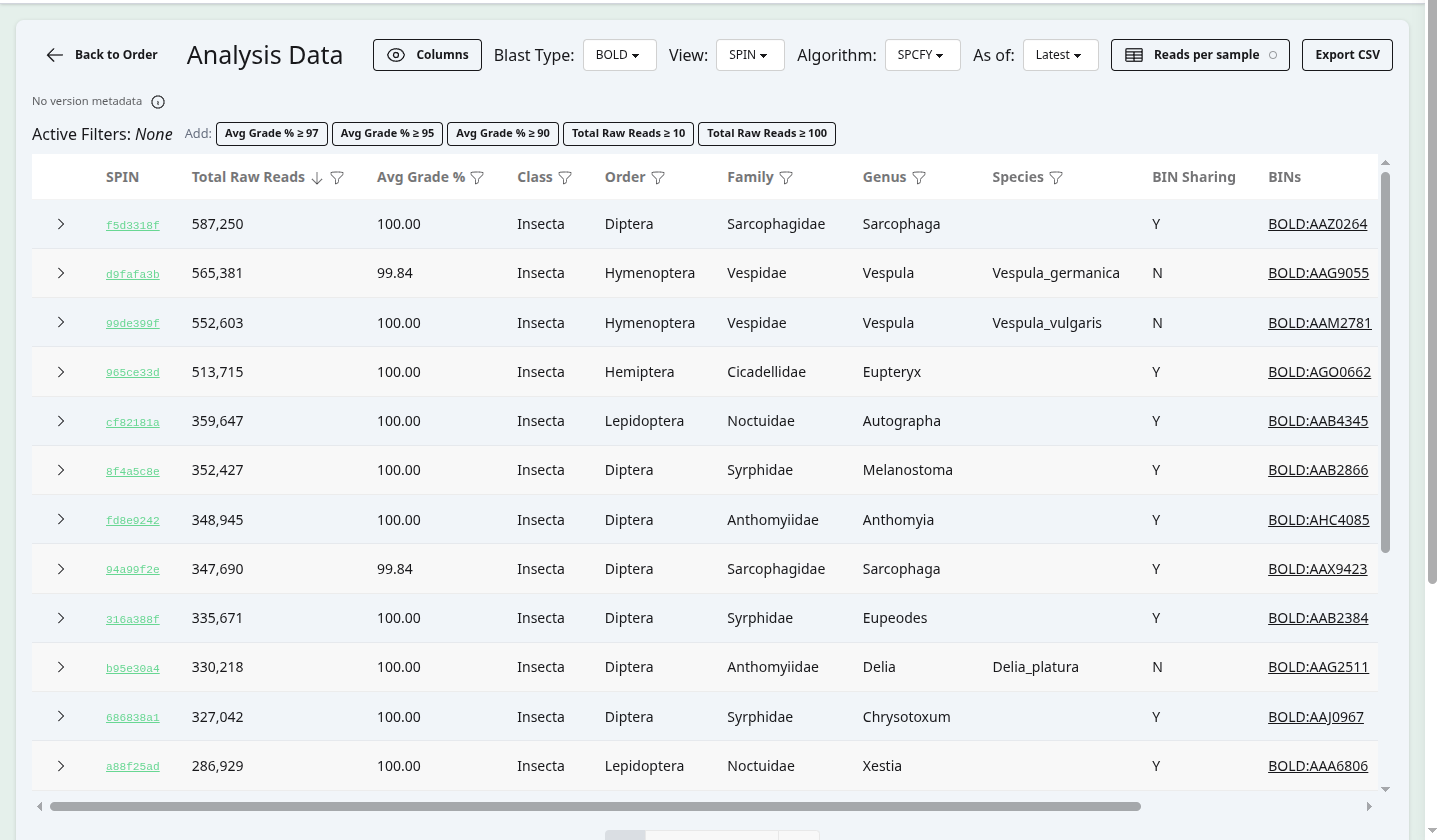
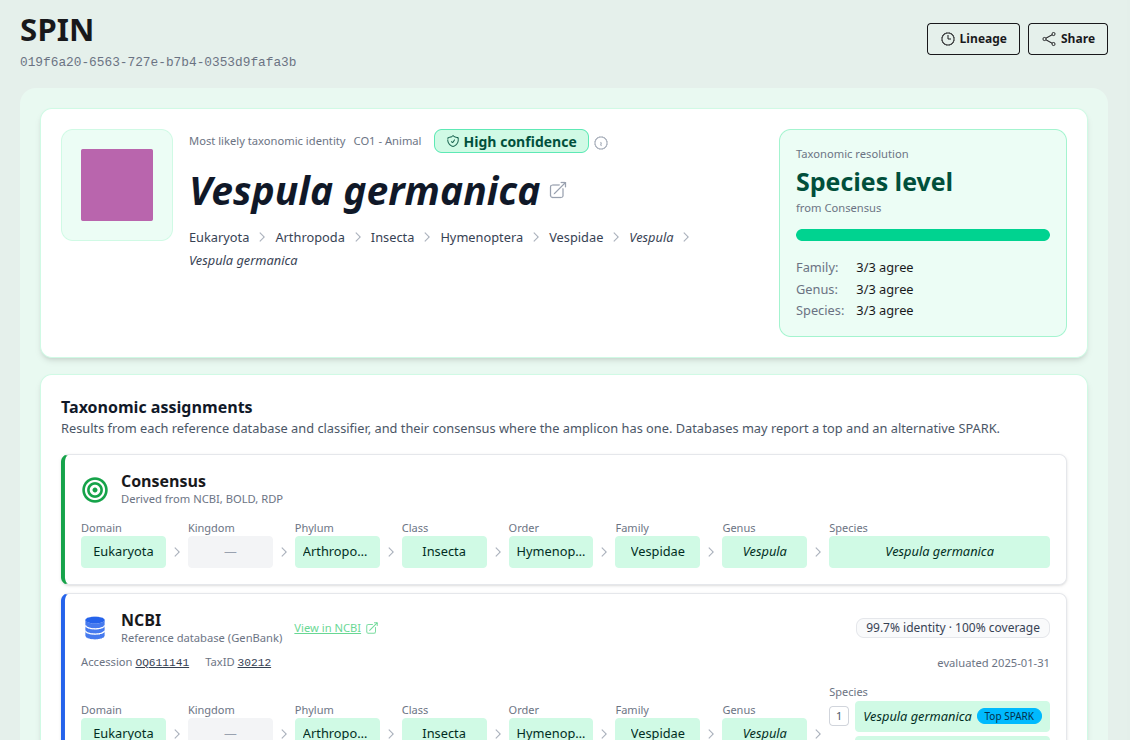
A SPIN is a DNA signal, not a species. One species often has several SPINs, because its sequences vary between populations or regions. Rarely, closely related species share near-identical sequences. The SPIN then shows this in its evidence, for example as a shared BOLD BIN.
Seeing SPINs in your own orders and projects requires spcfyINSIGHT, either your own license or one your lab extends to you on an order.The SPINs page and the individual SPIN pages are available to every signed-in user.
Your data stays yours. Full provenance, full control.
spcfy is built on data ownership as a first principle. Every dataset, raw and processed, is available for download at any time, in standard formats. No lock-in.
You own your data
All data is hosted in Germany, GDPR-compliant, with clear access controls. You decide who sees what, when, and in what format.
Every project carries a locked audit trail: pipeline version, reference database version, QC thresholds. Your results stay reproducible and citable.
Raw and processed datasets are available for download in standard formats at any time. Full data ownership is given from day one.
FAIR-aligned publishing, when you want it
In developmentWhen publication is the goal, spcfy is designed to make it straightforward. Standardized exports, Darwin Core compatibility, DOI-ready metadata, and full parameter provenance will travel with your dataset.
Direct connections to public repositories are currently in development. Once available, all exports will be structured for direct submission to:
Labs analyze, customers explore, and everything stays comparable.
spcfy is not a tool for one lab. It is shared infrastructure where every lab's output follows the same standard, so customers can actually compare results across labs and over time.
From sequencing run to client-ready delivery, without custom scripts or manual QC.
Four tiers. One ecosystem.
Start with the data foundation. Add analytical depth as your needs grow.
The data foundation. From raw FASTQ to standardized, comparable output.
The analytical layer. Explore, compare, and share biodiversity intelligence.
Predictive layers and Nature KPIs, built on top of INSIGHT.
Coming soonA natural-language interface for your biodiversity data, with API access to spcfy's built-in LLM or your own Claude or ChatGPT model.
Live, alpha
spcfy is a Silver Sponsor of iBOL 2026.
The 10th International Barcode of Life Conference brings around 500 scientists working in DNA barcoding and metabarcoding to Bangkok, this year under the theme "Building on Barcodes: Impacting Science and Society."
Come find us on site for a direct conversation about your workflow, your data, and whether spcfy fits.
Let's set up a time to talk.
Book an online demo before the conference, or find us on site in Bangkok. New accounts also get 4 weeks of freemium access with 15 processing credits, no commitment required.
From field sample to biodiversity signal.
On infrastructure built for this volume and complexity.
Questions first? Write to us at hello@spcfy.io